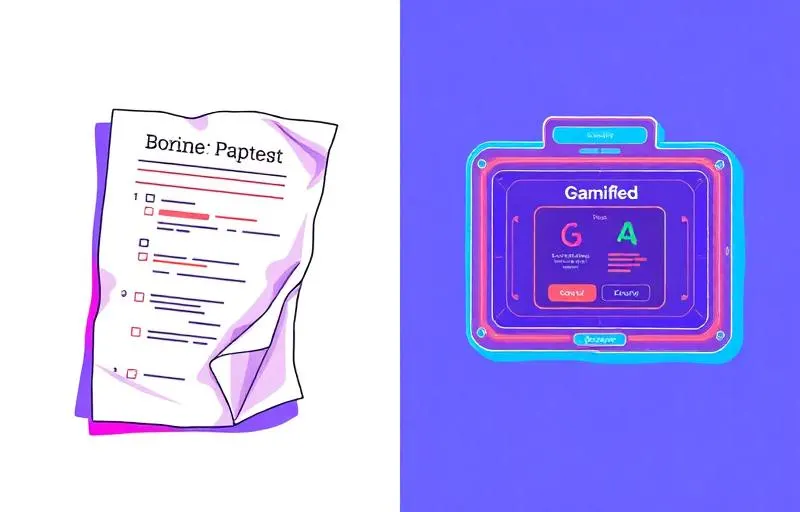
Traditional self-report tests remain useful, but the scientific literature shows clear limits: they rely on what people say about themselves, are vulnerable to socially desirable responding and faking, and may miss how people actually behave in context. That makes them insufficient as a stand-alone basis for high-stakes decisions such as talent identification, selection, or career guidance — even though they still retain practical value when used carefully and alongside stronger evidence sources.
The Appeal and Limits of Self-Report Questionnaires
For decades, self-report questionnaires have been among the most common tools for assessing personality and related individual differences in educational and organizational settings. Their appeal is easy to understand: they are efficient, standardized, easy to administer at scale, and often built on well-established models such as the Big Five or HEXACO. In many contexts, that makes them useful. But usefulness should not be confused with sufficiency. The more serious the decision, the more important it becomes to ask whether a person's self-description is enough evidence on its own.
The scientific sources point to the same basic limitation from several angles: self-report measures depend heavily on introspection and disclosure. In other words, they ask people to summarize themselves, often in abstract language, outside the situations in which the relevant traits are actually expressed. This is one reason game-based assessment has drawn attention as an alternative or complementary approach. Rather than asking people who they think they are, game-based formats attempt to capture choices, actions, and behavioral traces as they interact with structured tasks.
The Problem of Response Distortion
A central concern is response distortion. In employee selection, and by extension in other evaluative settings, applicants often have a clear incentive to present themselves in the most favorable possible way. The 2025 HEXACO-RUSH study notes that faking and social desirability have long been major problems in traditional personality assessment and cites earlier work showing that many candidates attempt to manage impressions on self-report measures. The broader 2025 review on game-related personality assessment reaches a similarly cautious conclusion: one of the major motivations for developing newer formats is precisely the concern that conventional self-reports are easy to distort in high-stakes settings.
This does not mean self-report data are worthless. It means they are vulnerable in predictable ways. A person may answer aspirationally rather than descriptively, may respond according to what seems professionally attractive, or may simply lack accurate insight into their own tendencies. In lower-stakes contexts this may be manageable, but in serious assessment environments it creates a structural problem: the method measures both the intended trait and the respondent's ability or motivation to manage impressions. When the goal is scientific accuracy, that is a meaningful limitation rather than a minor inconvenience.
Contextual Thinness: When Questions Are Too Abstract
A second limitation is contextual thinness. Many self-report items are intentionally general because they are designed to work across populations and settings. That standardization is useful, but it can also strip away the situations in which personality or judgment becomes visible. The literature repeatedly highlights the value of contextualized measures, especially situational formats, because people often reveal more informative differences when they must respond to concrete dilemmas rather than endorse abstract statements. This is one reason situational judgment tests and their gamified or game-based variants are discussed so often in the recent assessment literature.
What the Psychometric Evidence Actually Shows
The psychometric discussion also helps clarify what "not enough" should mean. The point is not that every new game-like tool is automatically superior. In fact, the review by Barends and Ohlms (2025) stresses that game-related personality assessments still need stronger evidence on discriminant validity, test-retest reliability, criterion validity, and fairness before strong claims can be made about their added value. The 2025 meta-analysis is supportive but careful: across 18 studies from 13 peer-reviewed articles, game-based assessments showed a moderate overall convergent validity with traditional self-report personality measures, with an overall effect size of r = .516, but the authors also reported substantial heterogeneity and emphasized the lack of standardized validation frameworks. That is not evidence that self-reports should be discarded. It is evidence that the field is moving toward richer, behaviorally anchored methods because self-reports alone leave important gaps.
A Middle Ground: The HEXACO-RUSH Study
The HEXACO-RUSH study illustrates this middle position well. Its authors did not argue that a gamified assessment should simply replace conventional measures. Instead, they showed preliminary construct alignment with the HEXACO model, with average correlations of .43 across six dimensions, while also finding that the gamified format was seen as more enjoyable and less easy to fake than the traditional HEXACO-60 in their within-sample comparison. At the same time, they explicitly noted the need for more research on test-retest reliability and criterion-related validity. That balance matters. The literature is not saying that old methods are useless and new methods are solved; it is saying that relying only on self-report is too narrow for serious decisions.
What This Means for Talero
For a company like Talero, this has an important implication. If the goal is to understand potential, work style, decision patterns, or future-oriented career fit, then an assessment approach should not depend entirely on what users claim about themselves in decontextualized questionnaires. A stronger model is to combine theory-driven design, behavioral evidence, and careful validation. In practice, that means designing experiences in which users make meaningful choices, generate process data, and encounter realistic or strategically constructed scenarios that reveal how they approach challenges. This is especially relevant in career guidance, where the objective is not only ranking people but helping them explore roles, skills, preferences, and future pathways in a way that feels informative rather than reductive.
Conclusion: One Component, Not the Whole System
So the most defensible conclusion from the research is straightforward. Traditional self-report tests are still useful as one source of information, especially because they are practical and often theoretically grounded. But they are not enough on their own for serious scientific assessment, because they are vulnerable to distortion, weakly contextualized, and limited in the kind of evidence they can produce about actual behavior. The future of high-quality assessment is therefore unlikely to be self-report versus game-based assessment. It is more likely to be a scientifically disciplined combination of methods in which self-report becomes one component of a broader evidence framework rather than the whole system.
References
- Nikolaou, I., & Katsadoraki, A. (2025). Construct validity and applicant reactions of a gamified personality assessment. Computers in Human Behavior, 162, 108467.
- Barends, A. J., & Ohlms, M. L. (2025). Game-related personality assessment. Current Opinion in Psychology, 65, 102095.
- Fadillah, Hidayat, R., & Santoso, A. (2025). Convergent validity of game-based assessment: A meta-analysis. International Journal of Serious Games, 12(4).
- Xenos, M., Christodoulopoulou, C., Mallas, A., & Garofalakis, J. (2019). The Future Time Traveller Project: Career guidance on future skills, jobs and career prospects of Generation Z through a game-based virtual world environment. Proceedings of the 10th International IEEE IISA Conference.
Ready to experience career discovery the way it should be?
Play Talero Now