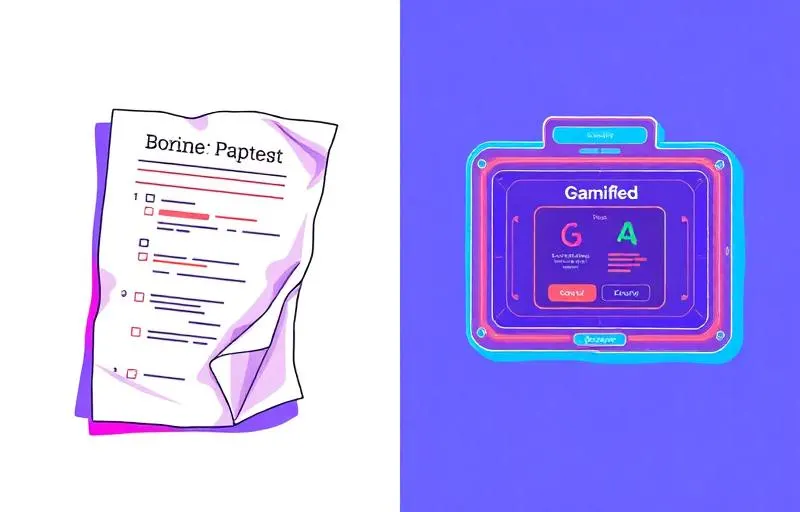
One of the most common claims made about gamified and game-based assessments is that they are harder to fake than traditional self-report questionnaires. The appeal of that claim is obvious. In high-stakes settings, people often have a strong incentive to present themselves in the best possible light. If a newer assessment format could reduce that problem, it would address one of the most persistent weaknesses of conventional personality testing. But the scientific evidence calls for a careful answer rather than a simple one. Yes, gamified assessments may offer some resistance to faking in some cases, but no, they should not be described as unfakeable.
Why Self-Report Measures Are Vulnerable
Traditional self-report measures are particularly vulnerable because their logic is often transparent. When a questionnaire asks people to rate statements about being organized, calm, honest, ambitious, or cooperative, many respondents can infer which answers seem favorable in a work or evaluation setting. Research on the HEXACO-RUSH gamified assessment situates its contribution against that background, noting that faking and response distortion have long been major concerns in personality assessment and that this has discouraged some employers from relying heavily on such tools. Earlier evidence suggests that many candidates attempt to create a more favorable impression on self-report measures. This does not invalidate self-report as a whole, but it explains why researchers have searched for alternatives that make impression management more difficult.
The Theoretical Case for Faking Resistance
The theoretical argument for greater faking resistance in game-related assessments is plausible. If assessment is embedded in narrative tasks, interactive scenarios, or full gameplay systems, then the person being assessed may find it harder to identify what is being measured or which response is strategically optimal. The HEXACO-RUSH paper argues precisely this point, suggesting that immersion, narrative framing, and fictional context may reduce the transparency of the "right" answer by making the scoring logic less obvious to the participant. A broader 2025 review by Barends and Ohlms also recognizes faking resistance as one of the main proposed advantages of game-related personality assessment. On paper, the promise is straightforward: the less obvious the intended trait and the less direct the self-description, the harder it should be for respondents to manipulate the result.
The Empirical Evidence Is Mixed
However, the review also makes clear that the empirical evidence is mixed and format-dependent. According to Barends and Ohlms, research on gamified and gamefully designed personality assessments has generally shown that these formats are often still just as fakeable as self-reports, although there are nuances and exceptions. That is an important correction to overconfident marketing language. Simply turning an assessment into a story, adding fantasy elements, or embedding it in a more visually engaging interface does not automatically remove the possibility of deliberate response manipulation. In some cases, participants may still infer what kind of person the assessment appears to reward and adjust their responses accordingly.
Gamified vs. Game-Based: A Critical Distinction
The distinction between gamified assessment and game-based assessment becomes especially important on this issue. Gamified assessments often remain structurally close to traditional instruments, even if they add narrative, imagery, or game-like framing. Because the core response format can remain transparent, such designs may improve experience without fundamentally changing fakeability. By contrast, full game-based assessments can collect evidence through more distributed and behaviorally embedded interactions, which may make direct manipulation harder. The review suggests that stronger evidence for partial resistance to faking has emerged particularly in some game-based personality assessments, rather than consistently across all gamified formats.
What Individual Studies Show
The studies summarized in the literature illustrate this distinction well. Barends and Ohlms note that Landers and Collmus found a gamified openness-to-experience measure to be fakeable to a degree comparable to self-report, while a gamified conscientiousness measure showed some resistance to faking. Even there, however, the picture was not simple, because the evidence suggested that faking resistance may have come with a possible reduction in convergent validity under fake conditions. In other words, even when a gamified format becomes somewhat harder to fake, researchers still need to ask what happens to measurement quality under those conditions. Reduced fakeability is helpful only if the assessment continues to measure the intended construct in a meaningful way.
The most encouraging evidence comes from work on the game-based personality assessment Building Docks, discussed in the 2025 review. Two experimental studies by Barends and De Vries suggested that the assessment was resistant to faking and that faking did not significantly reduce its convergent correlations with self-reported honesty-humility. A later experimental study by Ohlms and colleagues directly compared the fakeability of Building Docks with self-reported honesty-humility and found that both instruments were fakeable, but the faking effect was significantly weaker for the game-based assessment. This is one of the most scientifically useful conclusions in the current literature because it avoids absolute claims. The result was not that the game-based tool could not be manipulated, but that it appeared to be less vulnerable than the corresponding self-report.
Perceived Fakeability vs. Actual Fakeability
The HEXACO-RUSH study contributes to this discussion from another angle. In its applicant-reaction analyses, the gamified assessment was perceived as less easy to fake than the traditional HEXACO-60, with the largest observed difference between the two formats appearing on the "easiness to fake" dimension. Participants also found the gamified assessment more enjoyable and associated it with greater organizational attractiveness, while face validity and procedural justice did not significantly differ between the two formats. This matters because in assessment practice, perceptions of fakeability are not identical to actual fakeability, but they are still relevant. If participants perceive a method as less penetrable, that may affect how they engage with it and how fair they judge the process to be.
Why Sweeping Claims Are Premature
Still, the literature does not yet support sweeping claims that gamified assessment solves the faking problem. The review article is explicit on that point: game-related personality assessments may offer some resistance to faking, but they are clearly not completely resistant, and the mechanisms behind whatever protection they offer remain insufficiently understood. More research is needed on how faking influences criterion-related validity. It is possible for an assessment to appear robust in a laboratory comparison while still leaving unanswered questions about how manipulation affects prediction of real-world outcomes. In serious scientific work, that uncertainty has to be stated directly.
There is another reason to avoid exaggerated claims. Some of the very design features that may reduce transparency can also introduce new complexities. If a game includes fantasy, unfamiliar mechanics, or immersive narrative, then performance may be shaped not only by the intended trait but also by prior gaming experience, comfort with digital environments, reading style, or interpretation of the fictional setting. The HEXACO-RUSH study found that previous video-game experience moderated positive reactions to the gamified assessment. That does not mean the method is invalid, but it does mean that faking resistance cannot be considered in isolation from fairness, accessibility, and construct interpretation.
What This Means for Talero
For a platform like Talero, the responsible position is clear. It is scientifically defensible to say that certain game-based and some gamified assessments may be more resistant to faking than traditional self-report tools under some conditions. It is not scientifically defensible to say that these methods eliminate faking or make impression management impossible. A serious product should frame this as a design advantage that needs empirical validation, not as a solved problem. The strongest claim supported by the literature is comparative and conditional: embedding assessment in behaviorally rich, less transparent formats can reduce some opportunities for strategic response distortion, but the extent of that benefit varies by design and still requires careful psychometric study.
Conclusion: Resistant, Not Immune
Yes, people can fake gamified assessments. Some evidence suggests they may fake certain game-based formats less effectively than traditional self-report questionnaires, and some gamified assessments may also be perceived as less easy to fake. But the field does not support absolute promises of immunity. In a serious scientific area, the right claim is not "unfakeable." It is "potentially more resistant to faking than self-report, depending on the design, the construct, and the available validity evidence."
References
- Nikolaou, I., & Katsadoraki, A. (2025). Construct validity and applicant reactions of a gamified personality assessment. Computers in Human Behavior, 162, 108467.
- Barends, A. J., & Ohlms, M. L. (2025). Game-related personality assessment. Current Opinion in Psychology, 65, 102095.
- Fadillah, Hidayat, R., & Santoso, A. (2025). Convergent validity of game-based assessment: A meta-analysis. International Journal of Serious Games, 12(4).
Ready to experience career discovery the way it should be?
Play Talero Now